
April – May
SprinklerSpring Start-Ups
Charging a system back up sounds like turning a valve. It isn’t. Do it too early or too fast and you find out what the winter did to your pipes — all at once, at 60 PSI.
A start-up is the appointment that sets up your whole season. Water has been out of those lines since fall, the controller has been dark for five months, and somewhere in the yard a head has been clipped by a mower or heaved by frost. The job is to find all of that before your lawn depends on it.
Timing matters more than people expect in eastern Nebraska. Charge the system while the ground is still frozen and any water left in a line has nowhere to go but through the pipe wall. We wait for the frost to clear, then open the main slowly — a gradual fill so the system pressurizes instead of getting hit with a water hammer that can crack fittings and blow seals.
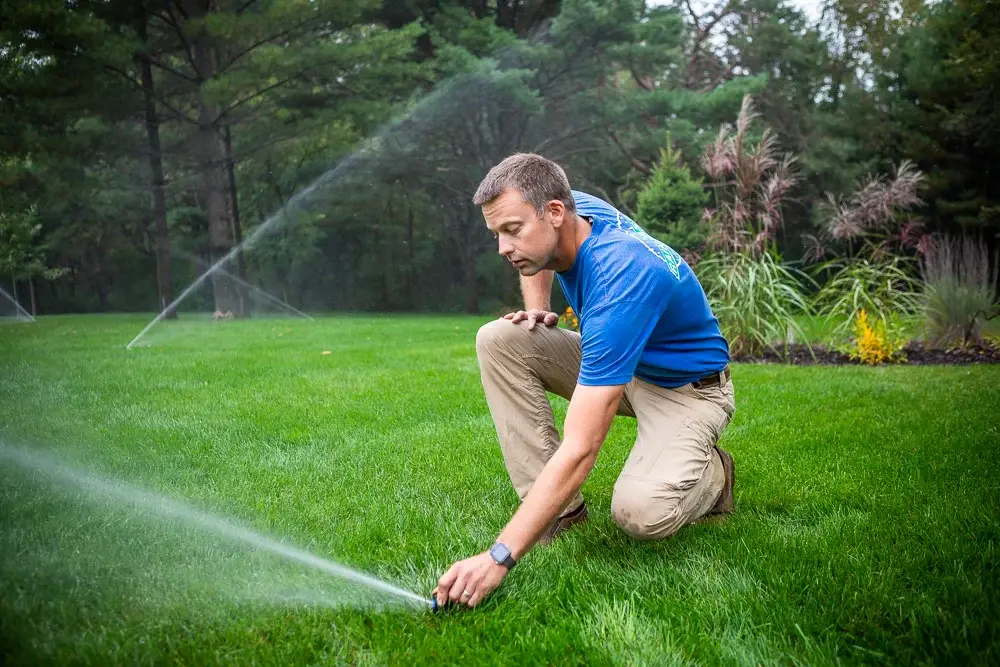
From there it’s methodical: run every zone, watch every head, and look at what the water is actually doing. Heads that spray the driveway, a rotor that has stopped rotating, a zone that has lost pressure because of a leak underground — these are cheap to fix in April and expensive to discover in July when a brown stripe shows up in the lawn.
What's included
- Slow, controlled fill
The main opens gradually so the system pressurizes without a water hammer that cracks fittings.
- Every zone run and watched
Not a sample — each zone gets cycled and observed while it runs.
- Head adjustment
Arcs and radii set so water lands on grass instead of the sidewalk, driveway, or street.
- Leak and break check
Looking for pooling, soft spots, and pressure loss that point to a line or fitting that didn’t survive winter.
- Backflow inspection
Visual check of the backflow assembly — the part that keeps irrigation water out of your drinking water.
- Controller programmed
Schedule set for spring conditions, not the August schedule it was still holding from last year.
Questions
Spring Start-Up,
answered.
When should I schedule a spring start-up in Nebraska?
Generally April into May, once the risk of a hard freeze has passed and the frost is out of the ground. Nebraska springs are unpredictable — a warm week in March is not the signal. Charging a system before the last freeze is one of the most common ways homeowners crack their own pipes.
Can’t I just turn it on myself?
You can, and plenty of people do. The risks are opening the main too fast and water-hammering the system, missing a slow leak that runs all season, and never checking your backflow. If you are comfortable filling slowly and walking every zone, a start-up is very doable. What you are paying us for is catching the things that don’t announce themselves.
What if you find something broken?
We tell you what it is, what it costs, and what happens if you leave it — before we touch it. You approve the number first. Some things genuinely can wait a season, and we will say so.
How long does it take?
For a typical residential system, most of a morning or afternoon depending on zone count and what turns up. A system that wintered well goes quickly; one with a broken line takes as long as the repair takes.
Also from us
System Repairs
Broken heads, cracked lines, dead valves, wiring faults — diagnosed and fixed, usually within days.
Learn more →Winterizations
Full compressed-air blowout so trapped water can’t freeze, crack your lines, and cost you a spring rebuild.
Learn more →New System Installs
Designed around your yard’s pressure, soil, and layout — then trenched and installed to the owner’s standard.
Learn more →

Let’s get your
system dialed in.
Free estimates. Straight pricing. Owner-operated, start to finish.
Mon–Fri: 8am – 5pm · Text us anytime at (402) 599-0552